

Why clean water?
For many of us, as we walk to the faucet and pour ourselves a drink of clean, safe water, it’s difficult to believe there are around 2 billion people worldwide that still do not have access to contamination-free water available on demand within their own home.1
The source of water for those 2 billion people can vary from collecting water from a public source like a river, which might be situated a considerable walk from home, to scraping water from large puddles or pools, often contaminated with animal or human feces.
It is estimated that around 1 million people a year die from diarrhoea because of unsafe drinking water, sanitation, and hand hygiene.1
Additionally, the collection of clean water from a well, river, or local source usually falls to women and girls and can take considerable time out of their day. That is time that is not spent in school or income-generating work. It is estimated that women and girls spend 200 million hours each day collecting water.1


How does the provision of safe water reduce emissions?
In many countries, once people have collected their water and carried it home, they boil the water to protect themselves and their family from waterborne diseases.
This is often done over a fire or rudimentary stove, burning unsustainable woody biomass (sticks and logs gathered locally in rural areas or charcoal which is bought in urban settings), contributes to deforestation.


Through the introduction of different devices, to provide people with safe water, the emissions from the burning of biomass to boil the water are reduced. As more than half of the world’s wood is harvested for cooking and heating, reducing demand is an essential element of the world’s efforts to tackle climate change. It may come as a surprise, but providing access to clean water is a deforestation solution.
- What technologies are used in safe water projects?
With ceramic water filters the water runs through tiny pores which remove solid matter and pathogens, making the water safe to drink. Our Clean Water and Cooking in Guatemala project uses this technology.
How does deforestation impact the climate?
Deforestation has multiple impacts on climate:
- When forests are cleared and burnt the carbon stored in the trees is released into the atmosphere.
- At the same time the number of trees is reduced, decreasing the potential for the forest to absorb carbon.
- Once trees have been removed, the land may be used for activities that increase carbon emissions, such as livestock farming, industrial infrastructure, or human habitation.
- Deforestation can also have a profound effect on rainfall patterns and local climate, which can have multiple knock-on effects on global climate change.
In 2019 around 70% of households in Sub-Saharan Africa and 44% of households in South-East Asia burned biomass to meet their household energy needs.2
Access to improved drinking water and sanitation, is critical to improving health and reducing poverty. Yet more than half of Guatemalans lack access to improved sanitation.
What other impacts does safe water provision bring?
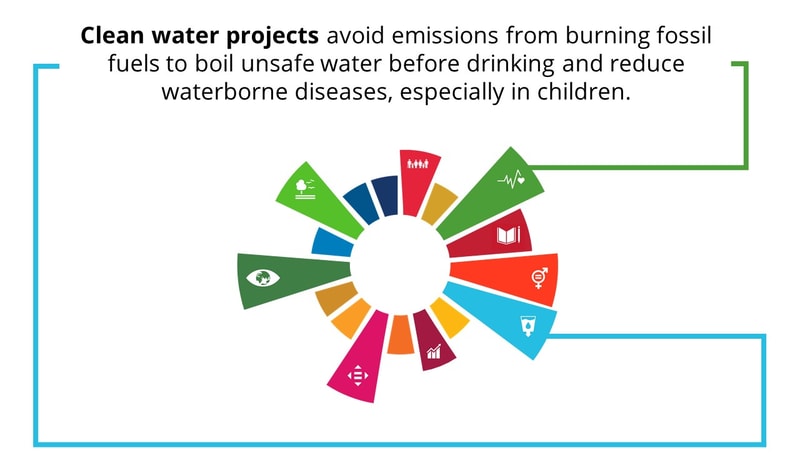
As well as avoiding emissions from burning fossil fuels to boil unsafe water before drinking it, clean water projects:
- Reduce waterborne diseases, especially in children
- Reduce exposure to harmful smokes and toxins in the kitchen, including dangerous particulate matter
It can also create employment for:
- Those installing and maintaining the clean water devices
- Those distributing devices and educating communities about the importance of safe water practices, such as WASH training.
What is WASH training?
WASH stands for Water Sanitation and Hygiene. Once safe water has been provided it is essential that people not only drink the treated water but also wash hands, faces, and food in it. High-quality safe water projects incorporate an element of education about WASH.
Turning on the Climate Action Tap
Sustainable Development Goals
In addition to delivering emissions reductions that help to combat climate change (SDG 13), safe water carbon projects most commonly support the following Sustainable Development Goals (SDGs) based on a sample of our projects:
1) End poverty in all its forms everywhere
3) Ensure healthy lives and promote well-being for all at all ages
4) Ensure inclusive and equitable quality education and promote lifelong learning opportunities for all
5) Achieve gender equality and empower all women and girls
6) Ensure availability and sustainable management of water and sanitation for all
8) Promote sustained, inclusive, and sustainable economic growth, full and productive employment, and decent work for all
10) Reduce inequality within and among countries
13) Take urgent action to combat climate change and its impacts
15) Protect, restore, and promote sustainable use of terrestrial ecosystems, sustainably manage forests, combat desertification, and halt and reverse land degradation and halt biodiversity loss
Examples of Climate Impact Partners’ clean water projects
Our 360 videos bring the projects to life. Click below to learn more about three different types of safe water intervention.
Tips for watching a 360 video:
- On screen - use your mouse to move around the screen and view from all directions.
- On your phone - move the phone itself to view the scene from all angles.
- Virtual reality headset –this gives the best experience!
Household water filters in Guatemala
Ecofiltro provides safe water to customers throughout Guatemala, through these household ceramic water filters.
School and institutional water filters in rural Kenya
Aqua Clara works with schools and other institutions to provide safe water as well as providing household microfiber filters.
Water infrastructure project, Africa
See how the restoration of community boreholes to pump clean groundwater is reducing emissions and improving people’s health.


Looking for solutions?
Safe water methodologies
All the carbon projects that we support, including clean water projects, are independently verified and validated in line with recognized global standards as well as being screened through our ten-stage Quality Assurance process by our expert team. Below are examples of safe water project methodologies from Gold Standard and the Clean Development Mechanism (CDM).
Gold Standard
Methodology for Emission reductions from Safe Drinking Water Supply V.1
CDM
Low greenhouse gas emitting safe drinking water production systems V.8
AM0086: Distribution of zero energy water purification systems for safe drinking water V.4.0
References
1 WHO: Drinking-water (who.int)
2 Quantifying Greenhouse Gas Emissions from Woodfuel use in Households. essd-2022-390.pdf (copernicus.org)


