

This Q&A addresses your top questions about the SBTi's Corporate Net Zero Standard V2.0.
For a deeper dive, watch our recent webinar recording or read our insights article - Navigating the SBTi's Proposed Net-Zero Revisions.
- What is the SBTi’s Corporate Net Zero Standard?
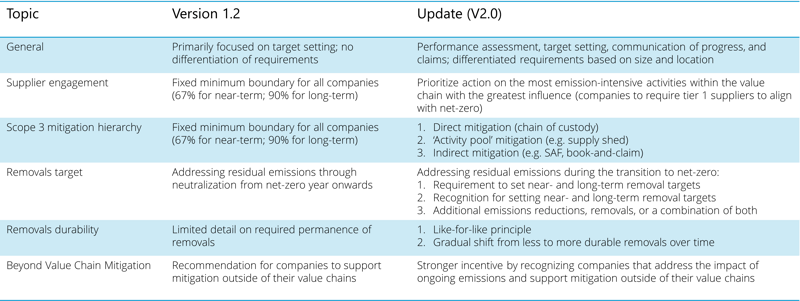
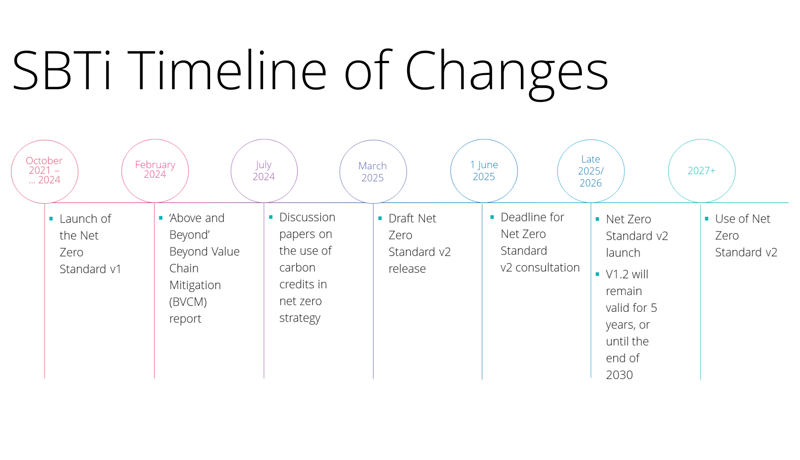
Launched in 2021 (V1.0, now V1.2), the SBTi's Corporate Net-Zero Standard provides a framework for businesses to set validated, science-based targets on their path to achieving net-zero emissions, aligned with the Paris Agreement. Driven by the urgency of the climate crisis and the latest scientific understanding, more substantial changes have been outlined in the draft V2.0 - out for consultation until 1 June 2025.
- What's changing in version 2 of the Net Zero Standard?
Nothing in the draft is final. However, the updates point towards a direction of travel, particularly regarding the use of carbon credits on the road to Net Zero.
- When will changes to the SBTi's Corporate Net Zero Standard happen?
See the timeline below to understand when the proposed changes may come into effect.
- Is the SBTi’s current Net Zero Standard (V1.2) still valid?
- Are the standards likely to change further in light of the wider move to reduce the burden of additional reporting requirements?
One of the aims is to reduce the burden of additional reporting and ensure alignment across frameworks. The intention is to balance robustness and credibility without overburdening companies, and there is ongoing consultation and iteration to ensure that.
Supply Chain & Supplier Obligations
The SBTi proposes requiring (or potentially recommending) companies to engage their tier 1 suppliers in setting their own net-zero targets. This initiative aims to drive decarbonization across Scope 3 emissions through influence, prioritizing emissions-intensive activities.
- What is the definition of a Tier 1 supplier?
A Tier 1 supplier is a company that directly provides goods or services to the customer, forming the closest level of the supply chain. These supplier have direct business relationships and contracts with the company, meaning they purchase directly from them.
- Does the requirement to set net zero targets risk overwhelming smaller suppliers?
Yes, this concern was acknowledged by the SBTi, with the importance of providing support to smaller suppliers emphasized. The SBTi understands that for some suppliers, especially in hard-to-abate sectors, setting targets will be more difficult. This is why timelines, sector-specific guidance, and capacity building are critical.
- How can Tier 1 suppliers in hard-to-abate industries realistically set net zero targets?
The SBTi recognizes this challenge and is developing sector-specific pathways, such as for cement, steel, and aviation. These pathways account for technological readiness and allow for tailored transition strategies. The importance of feasibility and realistic timelines was emphasized.
Mitigation Hierarchy for Scope 3 Emissions
The new guidance introduces recognition and acknowledgement of "indirect mitigation" measures and "supply shed" concepts, addressing the complexities of Scope 3 emissions.
- What are the implications of the changes to Scope 3 on supply chain decarbonization efforts, including insetting?
The SBTi is proposing three approaches for addressing supply chain emissions (scope 3), in an order of priority:
- Will insetting be permitted for Scope 3 target achievement, specifically the use of book and claim programs?
Further clarity is needed from the SBTi with regards to insetting in the final version of the new Net Zero Standard. The ‘supply shed’ concept could allow for recognition of abatement from insetting projects, even where there is no physical traceability of a product in the value chain.
- Will there be recognition of carbon avoidance credits for offsetting/mitigating "ongoing emissions" and/or Scope 3 emissions?
- Can market-based instruments like Green Gas certificates, Renewable Gas Guarantees of Origin, Sustainable Aviation Fuel (SAF) be used to meet Net-Zero targets under the SBTi standard?
The SBTi is exploring the acknowledgement of market based mechanisms in recognizing abatement. Further clarity on their treatment under the current standard is required, and companies should consult with the SBTi in the meantime. The GHG Protocol is undergoing a review process to give guidance on the treatment of market instruments in GHG accounting methodologies, due to the current lack of clarity.
- How will the SBTi steer clear of the subjectivity trap on accepted methods for offsetting?
The SBTi plans to align with robust, credible frameworks and criteria, such as the ICVCM (Integrity Council for the Voluntary Carbon Market) and the Oxford Offsetting Principles. The aim is to avoid subjectivity by setting science-based guardrails and being transparent about criteria.
Carbon Removals Targets
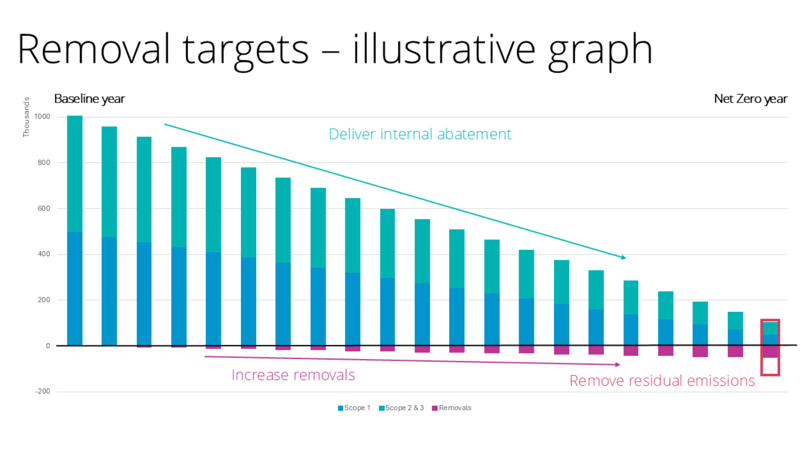
A significant shift is the introduction of a "Removals Target" for Scope 1 emissions. Scope 2 and Scope 3 emissions are excluded from the removals target.
- What is the scope of usage of carbon credits in the draft new standard?
- Is there guidance on allowable carbon credits for residual emissions?
The SBTi is likely to provide more information on allowable carbon credits in the final version of the standard, such as allowable standards or quality criteria, e.g. the use of CCP-labelled credits.
- Will companies be able to count the gradual use of carbon removals towards their annual SBTi approved Net Zero Carbon targets, in addition to reductions?
For example, if in a given year a company reduces emissions by 3% and also purchases Scope 1 removals for 1%, will they be able to claim a 4% improvement towards their net-zero target that year?
- Are carbon removal credits not also offsets?
SBTi is clear that it does not allow carbon credits (often called offsets) to count as a reduction in an organization’s GHG inventory, as a substitute or replacement for abatement.
- Under the removals target, removals need to increase over time. Can companies also remove or compensate all emissions in the interim period?
Companies can use carbon credits to remove or avoid emissions on the pathway to net zero, which SBTi calls Beyond Value Chain Mitigation (BVCM). Organizations could choose to deliver BVCM outcomes using carbon credits in addition to the removals target and the SBTi is considering whether the removals target will be mandatory or recommended.
- Will companies be penalized for not increasing removals because of reducing emissions according to the abatement target?
The removals target is a gradual increase of removals over time until 100% of residual Scope 1 emissions is matched by the net zero year. It’s possible that if target Scope 1 emissions are expected to be zero at the net zero year, then the removals target will also be zero.
- Has the SBTi indicated which removals target option and removals durability approach they are leaning towards?
Not that we are aware of - and both options are on the table to be considered. Based on the feedback we hear from our clients, we expect users of the Net Zero Standard will look for pragmatism and lower complexity, which may favour the 'optional' route for the removals target, and transitional durability route.
- How could demand in the voluntary carbon market (VCM) be impacted as a result of the proposed removals target and durability requirements?
We expect the VCM demand to increase due to:
- Compensating for methane emissions (12 years residence time) with short lived removals – would this be logical if the removals are CO2 removals but the emissions are methane?
The impact of carbon credits are measured in ‘tonnes CO2e’ which takes into account durability of different greenhouse gases.
Additional Recognition & Beyond Value Chain Mitigation
The SBTi proposes formal recognition for delivering mitigation activities beyond the value chain, known as Beyond Value Chain Mitigation (BVCM), to address the impact of ongoing emissions. BVCM encompasses activities that reduce or remove emissions outside of a company’s value chain.
- Through which mechanisms can companies contribute outside of their value chain?
The most common way of contributing outside of the value chain is by purchasing high quality carbon credits. There are other options, which include investing in nascent technologies to advance climate mitigation in the future.
- Between tackling Scope 1 emissions and BVCM initiatives, how should companies prioritize or strategize their plans?
The guidance is clear that companies should focus on reducing Scope 1, 2, and 3 emissions in line with science before relying on BVCM (Beyond Value Chain Mitigation):
- Do you think "additional recognition" for BVCM action is sufficient? And what form should this additional recognition take?
The concept of “additional recognition” is under discussion. The idea is to provide space for companies to get credit for BVCM without it being a substitute for internal reductions. Some suggestions included public acknowledgment, registry features, or differentiated scoring.
- Is there a difference between a carbon credit used for BVCM vs compensation of residual emissions?
For ongoing emissions, i.e. on the journey to reach net zero, companies are recommended to contribute to BVCM activities, most commonly through the purchase of high quality carbon credits, according to their levels of ongoing emissions (i.e. Scopes 1,2,3 at any given time until the net zero year).


