

Is carbon really a commodity?
In economics, a commodity is a resource that is fully fungible, meaning the market will pay the same price for the resource no matter where it came from.
Everyone knows that gold is gold and no matter where it came from all gold can be smelted into the coins, bars, and bullion that are the very image of wealth. So, if you had the choice between two bags of gold that are the same weight, you cannot go wrong, they are almost always worth the same. Or said another way, they are both worth their weight in gold.
However, this rule of fungibility does not apply to all resources.
Diamonds may be forever, but we know that no two diamonds are the same. Choosing the wrong one can break the bank and even break a heart. So, if you had the choice between two bags of diamonds that are the same weight, well, good luck picking the one worth more. One could be infinitely more valuable than the other based on each diamond’s characteristics, their five C’s.
Five C’s of diamonds:
- Carat
- Cut
- Clarity
- Color
- Certification
How can this analogy help someone understand carbon markets? Well, a carbon credit must represent 1 metric tonne of carbon dioxide or the equivalent (tCO2e) that is either reduced or removed from the atmosphere. That’s where the phrase a tonne is a tonne comes from as the atmosphere does not care what region or project type the carbon mitigation or sequestration comes from. It’s one tonne either not going up or coming out.
So, while there is an element of fungibility in the market, as all carbon credits equal the same weight of carbon, and all should align with ICROA’s code of best practice: real, measurable, permanent, additional, independently verified, and unique to be allowed on a public registry where it can be traded and retired as an offset. That’s what all carbon credits have in common, but just because they have a lot in common, does not make carbon a commodity. To illustrate the characteristics of a carbon credit that can determine its price, we introduce the five C’s of carbon credits:
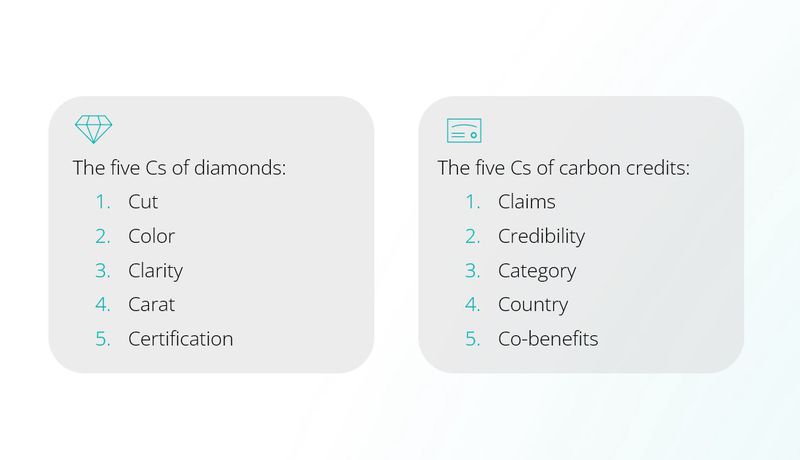
Five C’s of carbon credits
Five C’s of carbon credits:
- Claims - The claim you make defines what credits you will need. For example, types of claims include: Contribution or compensation? Net Zero or CarbonNeutral? SBTi, ISO, or VCMI? We help you decide on the right claim and source the right credits.
- Credibility – There is no single marker of credibility and quality in our market, that’s why we perform our own due diligence. Some labels are at the methodology level, like the Core Carbon Principles (CCP) from the Integrity Council for the Voluntary Carbon Market (ICVCM), while others are at the project level, such as scores from ratings agencies like BeZero or Sylvera.
- Category – All carbon credits fit roughly into four categories: Projects either avoid or remove carbon through nature- or tech-based interventions. In order of price from lowest to highest, it tends to go Tech-based Avoidance, Nature-based Avoidance, Nature-based Removal, and then Tech-based Removal.
- Country – Project location can determine its eligibility for carbon finance and cost of implementation, even under the same methodology. For example, two nature-based removals projects that both plant trees will need to do so in different ways according to the local context of each country.
- Co-benefits – Every credit delivers one tonne of carbon impact. But each project has unique co-benefits for the local communities and environment. Based on your brand values, we can help you choose the right project to support specific UN Sustainable Development Goals (SDGs).
There we have it. No doubt we could come up with other ‘c’ variables to demonstrate the point. We need everyone in the world to get just as excited about the potential to reduce or remove carbon from the atmosphere as they may about the potential to mine and buy gold or diamonds. Ideally more excited. But just remember, when it comes to understanding prices in carbon markets, think diamonds not gold.
Les toutes dernières Insights de
Climate Impact Partners
How Energy Attribute Certificates (EACs) Support LEED® v4/v4.1
A practical, plain language overview for sustainability, real estate and LEED driven-organizations
Pour en savoir plus
Article 6 Insights
Here we provide a refresher on Article 6, explore how the latest updates impact credit portfolios, and when alignment with Article 6 is optional or obligatory.
Pour en savoir plus
Market Outlook 2026: Why the Carbon Market Is Positioned for Growth
As climate ambition accelerates globally, the carbon market enters 2026 with renewed momentum. Explore the key themes shaping the market.
Pour en savoir plus
Les toutes dernières Insights de
Climate Impact Partners
How Energy Attribute Certificates (EACs) Support LEED® v4/v4.1
A practical, plain language overview for sustainability, real estate and LEED driven-organizations
Pour en savoir plus
Article 6 Insights
Here we provide a refresher on Article 6, explore how the latest updates impact credit portfolios, and when alignment with Article 6 is optional or obligatory.
Pour en savoir plus
Market Outlook 2026: Why the Carbon Market Is Positioned for Growth
As climate ambition accelerates globally, the carbon market enters 2026 with renewed momentum. Explore the key themes shaping the market.
Pour en savoir plus