
How to Balance a Carbon Credit Portfolio
Watch the full webinar recording to explore how to design a balanced carbon credit portfolio, combining near term action with long term ambition to deliver real value for business and climate.
Carbon credits are not one-size-fits-all. Like diamonds, two portfolios with the same volume and spend can deliver very different outcomes depending on what’s inside. As scrutiny grows around quality, claims and credibility, building the right carbon portfolio requires more than price comparisons – it requires a clear view of the market and confidence in your organization’s decisions.
At Climate Impact Partners, we use a simple framework to help clients build portfolios that match their goals and constraints: the Five C’s (Claims, Credibility, Category, Country and Co-benefits).
In a recent webinar, Climate Impact Partners experts Immy Hartley and James White shared practical guidance on building a balanced, defensible carbon credit portfolio. This article will distil the key insights – helping businesses align portfolio choices to climate ambitions, budgets, targets and risk tolerance, and make decisions they can stand behind.
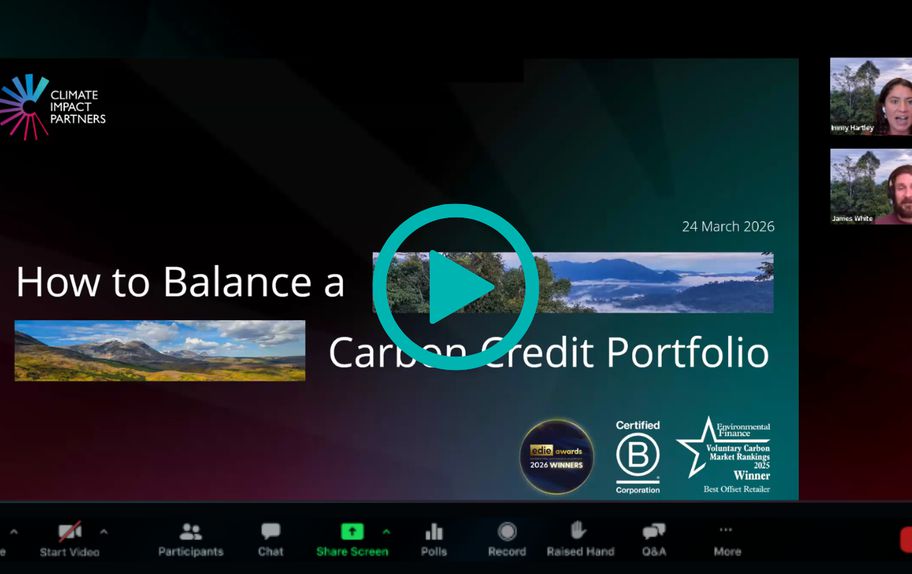
Watch the full webinar recording to explore how to design a balanced carbon credit portfolio, combining near term action with long term ambition to deliver real value for business and climate.
The carbon market is always changing, but your business needs to get started and evolve with it. In the webinar, our experts outlined four takeaways to help organizations understand where to start and how to scale a carbon credit portfolio over time.
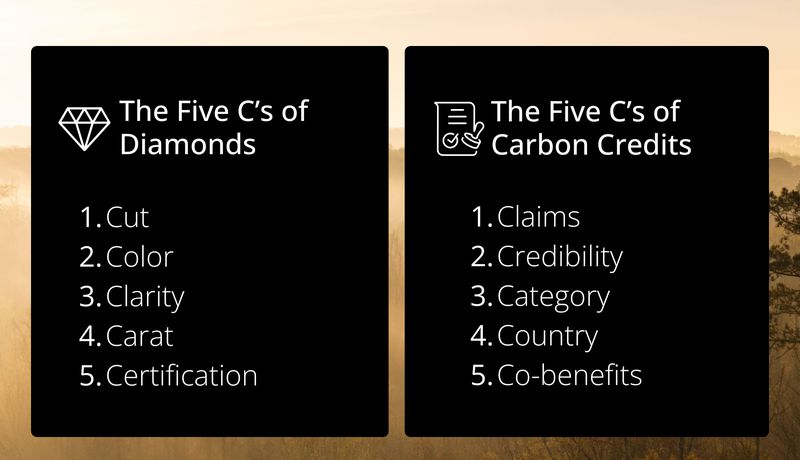
Let’s revisit our analogy of diamonds – no two are truly the same. That’s why the diamond industry relies on a succinct, shared way to compare value: a small set of characteristics that help buyers evaluate like-for-like, even when two stones are the same “weight.” They follow a framework of five C’s: Carat, Cut, Clarity, Color and Certification.
Carbon credits work in a similar way. Each credit represents 1 metric ton of carbon dioxide (or equivalent, tCO2e) reduced or removed, which is where the phrase “a ton is a ton” comes from. But the projects behind those tons can differ materially in ways that affect credibility, risk, fit-for-purpose use and, ultimately, price. In practice, buyers are balancing more than “quality” in the abstract: budget, procurement constraints and delivery/risk tolerance all influence what a balanced portfolio looks like.
Price varies enormously by project type, geography, vintage (the year credits were verified) and certification level, so organizations – especially those with large volumes or tight budgets – need to weigh cost per ton against the quality signals and the story they want to tell. Vintage and delivery risk (pre-issuance vs. issued) are also closely linked considerations, particularly for multi-year programs.
Climate Impact Partners has taken a similar approach - using five lenses (the Five C’s) to build a robust, rigorous carbon credit portfolio: Claims, Credibility, Category, Country and Co-benefits.
Five C’s of carbon credits
Cost underpins every choice, because budgets, procurement requirements and risk tolerance shape what’s feasible – and prices vary by project type, geography, vintage and certification.
These five lenses help you make structured trade-offs as you build (and evolve) a portfolio – starting with the claims you need to make, then working through credibility and project mix. And throughout, cost remains constant: the right answer is the one that meets your objectives within your budget and risk parameters.
Aviva
Schroders
The Girls Day School Trust
Tandem
British Land
Boston Consulting Group
Bondhu Foundation
Linklaters
Aqua Clara
The Co-operative Group
Ecofiltro
Swedish Energy Agency
Econegocios
Government of Kenya
Arup
Government of Norway
Baillie Gifford
Government of South Sudan
FCDO
Co-operative Insurance
Logitech
Contact us if your business is interested in building a robust and credible carbon portfolio